

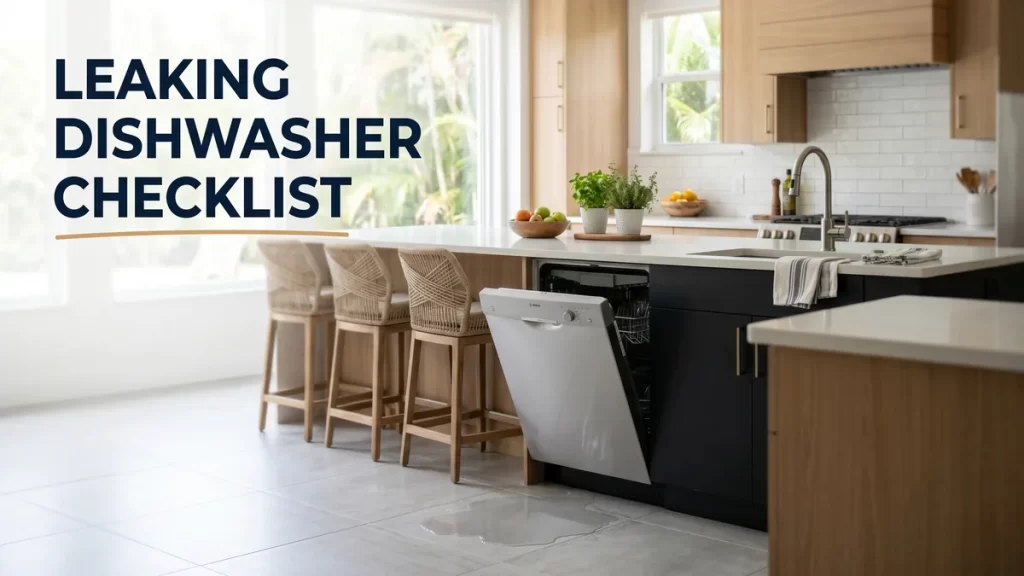
You open the dishwasher to put away clean dishes and find a small puddle creeping out from under the door, or worse, a damp spot spreading across the kitchen floor. Annoying, sure, but try not to panic. A leaking dishwasher is one of the more solvable appliance problems, and a lot of the time the cause is something simple you can spot yourself. This checklist walks you through it step by step, from the quick stuff to the point where it is smarter to call in our dishwasher service in Jacksonville.
Work down the list in order. Each item rules out a likely cause, so by the time you reach the bottom you will either have fixed the leak or know exactly what to tell a technician.
In this article
- 1. Stop the leak and dry the area
- 2. Check the door gasket and latch
- 3. Make sure the dishwasher is level
- 4. Rule out the wrong detergent
- 5. Inspect the spray arm and tub
- 6. Look at the hoses and connections
- 7. Factor in Jacksonville’s water
- 8. Know when to call a technician
- Frequently asked questions
1. Stop the leak and dry the area
Safety first: The tips here are for general guidance only. Max Appliance Repair Jacksonville is not responsible for any damage, injury, or cost resulting from action taken based on this content. Always unplug an appliance before you inspect it. Never attempt natural gas, refrigerant, or major electrical repairs yourself. If a step calls for anything you are not fully comfortable with, stop and call a licensed appliance technician.
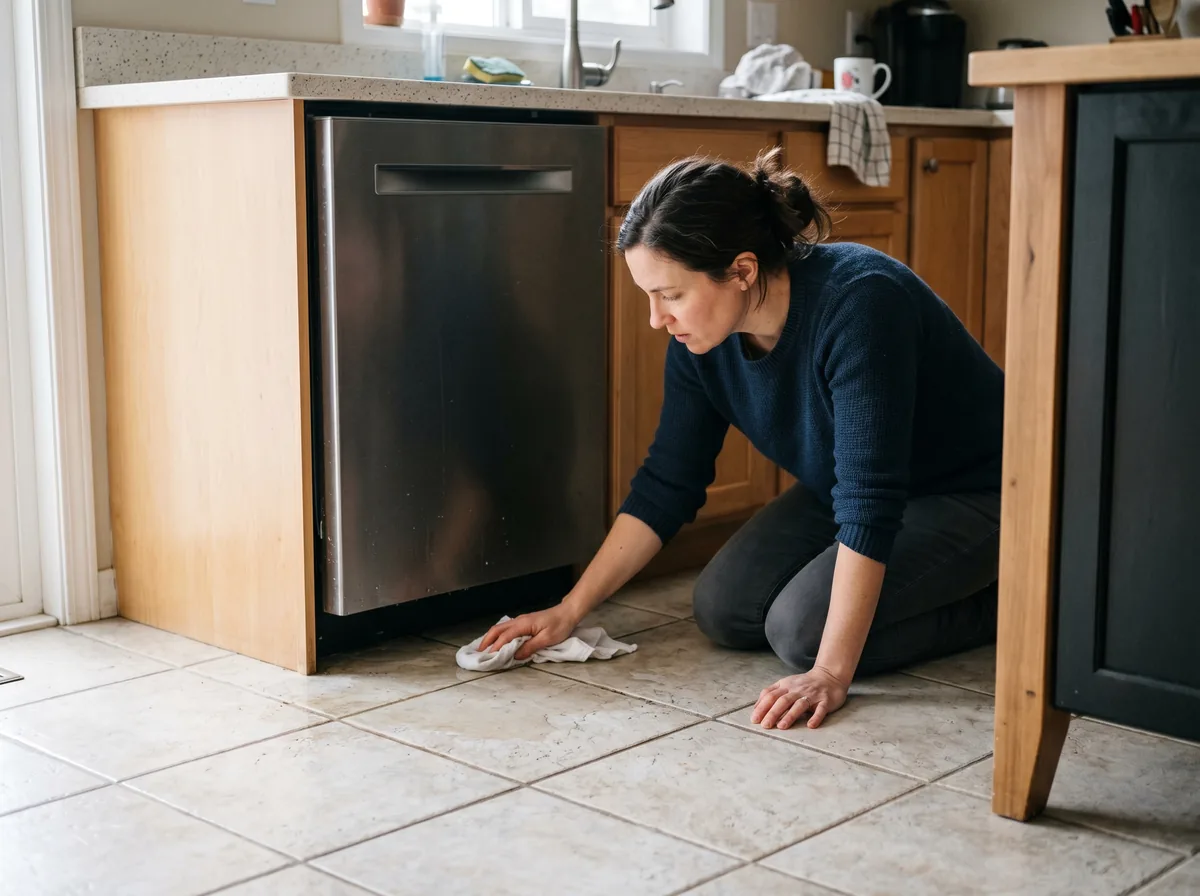
First things first. Stop the cycle, then dry the floor so you can actually see where the water is coming from. A wet floor near an appliance is a slip hazard and, if it reaches an outlet, an electrical one too. Wipe it up, place a towel where the water pooled, and run the dishwasher for a minute or two so you can watch the leak happen in real time. Knowing whether it drips from the door, the base, or the back changes everything about the fix.
2. Check the door gasket and latch
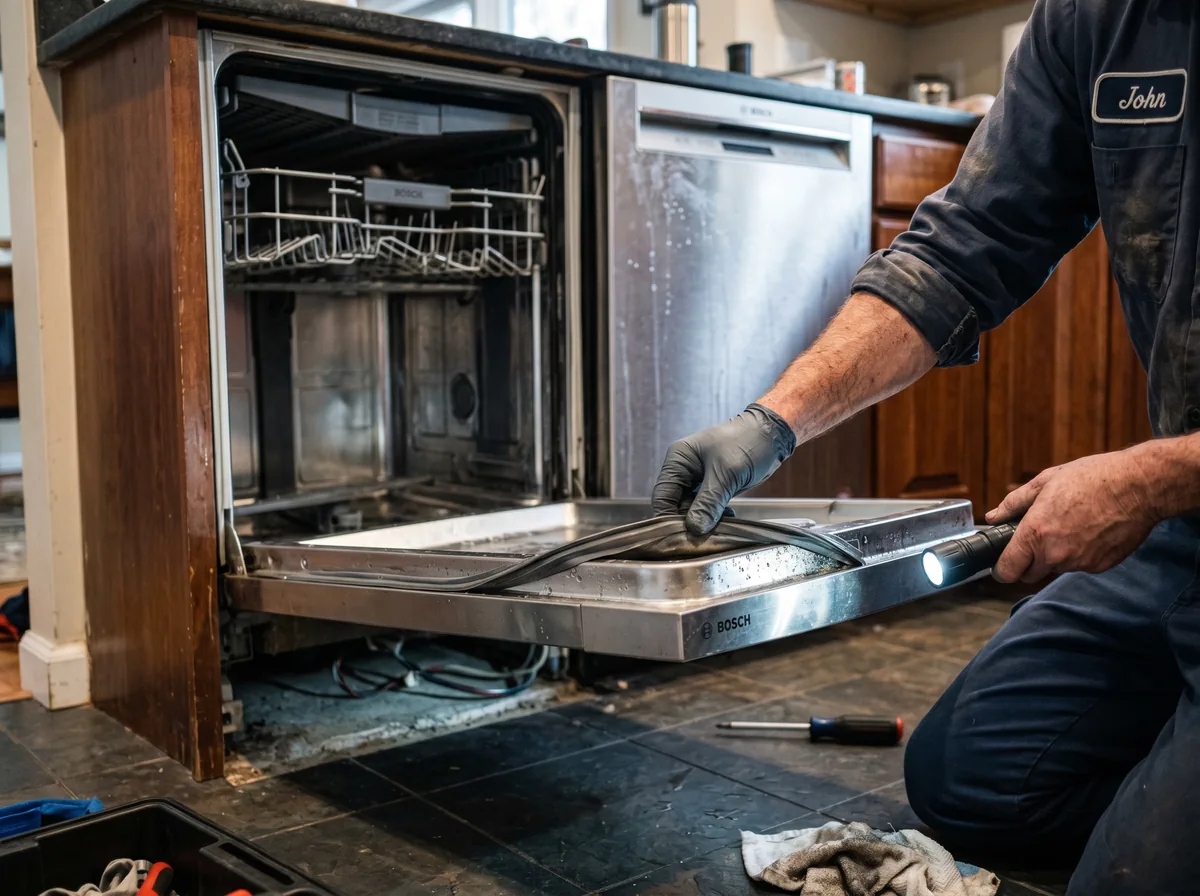
If the water shows up at the top or sides of the front panel, the main tub seal is the usual suspect. Run your finger around the rubber gasket that lines the sides and top of the tub opening. You are feeling for cracks, brittle spots, or a section that has popped out. (Note: dishwashers do not have a full rubber seal across the bottom of the door, they rely on gravity and a deflector). Wipe the side and top gaskets clean with warm soapy water, press it back into place, and check that the door latches firmly. A gasket that is simply dirty often seals fine again once it is clean.
Save your money: clean before you replace
Before you order a new door gasket, give the old one a proper clean and let it warm up. Cold, stiff seals and ones caked with grease leak even when they are not actually worn out. A five-minute wipe-down fixes a surprising number of front-door leaks for free. Only replace the gasket if it is cracked, torn, or permanently deformed after cleaning.
3. Make sure the dishwasher is level
A dishwasher that sits even slightly off level can let water pool on one side and spill past the door or the tub seals. This happens more than you would think, especially after a kitchen reno or if the unit was bumped during cleaning. Set a small level on the bottom rack or the door edge. If it is off, the leveling feet at the corners usually twist up or down by hand or with a wrench to bring it back true.
4. Rule out the wrong detergent
This one catches a lot of people. Regular dish soap, the kind for handwashing, creates a mountain of suds in a dishwasher, and those suds push water right out the door. If you ran out of dishwasher detergent and improvised with hand soap, that is almost certainly your leak. Run an empty rinse cycle to clear the suds, then switch back to proper dishwasher detergent or pods. No part is broken; the machine just got the wrong fuel.
Did you know: too much detergent leaks too
Even the right detergent causes problems in the wrong amount. Overfilling the dispenser, especially with soft or conditioned water, produces excess suds that behave just like hand soap and force water past the door seal. In many Jacksonville homes with hard water you may need a bit more detergent, but if you have a water softener, you often need less. Match the dose to your water and the leak frequently disappears.
5. Inspect the spray arm and tub
Open the door and spin each spray arm by hand. If one is cracked, clogged, or knocked loose, water can spray at the door seam instead of down onto the dishes, and it ends up on your floor. While you are in there, glance at the bottom of the tub and the area around the filter for any standing water, debris, or a cracked tub, which is a more serious find. Clear any food buildup from the filter; a clogged filter can back water up and over.
6. Look at the hoses and connections
If the water is showing up at the back or underneath rather than at the door, the source is likely a hose or a connection. With the dishwasher off, look at the water supply line and the drain hose where they connect. Loose clamps, a cracked hose, or a worn connection at the pump can all weep water that runs along the base and out the front, fooling you into thinking it is a door problem.
People often ask: where is the water actually coming from?
It is the most useful question you can answer, because front leaks and base leaks point to completely different parts. Water at the front edge of the door usually means the gasket, latch, or detergent. Water appearing at the base or back, or only after a load finishes draining, usually means a hose, clamp, pump, or tub issue. Dry everything, run a short cycle, and watch closely. The location tells you, and a technician, where to look first.
7. Factor in Jacksonville’s water
Northeast Florida has notably hard water, and over time the minerals leave scale on seals, spray arms, and the inside of the tub. Mineral buildup can hold a door gasket open just enough to weep, and it clogs spray arm jets so water sprays sideways. If your dishwasher has been leaking on and off and you have hard water, descaling the machine with a dishwasher cleaner is worth a try. Our rundown on how hard water affects Jacksonville appliances covers what the minerals do and how to stay ahead of them.
8. Know when to call a technician
You have cleaned the gasket, leveled the unit, fixed the detergent, checked the spray arms, and eyeballed the hoses, and it is still leaking. At that point the cause is usually inside, a failing pump seal, a cracked tub, a faulty water inlet valve, or a worn door spring. Those repairs mean pulling the dishwasher and working with water lines and wiring, which is the right time to hand it off.
Final thoughts
Most dishwasher leaks are not caused by catastrophic failures. More often, the culprit is a dirty gasket, an uneven installation, excess detergent, or a minor blockage that can be corrected in minutes. Working through the checklist methodically helps narrow down the source and may save you an unnecessary repair bill. If the leak persists after the basic checks, it is usually a sign of an internal component issue that should be diagnosed before water damage becomes a much larger problem.
Sources and further reading
- ENERGY STAR, dishwasher care and efficiency guidance. energystar.gov
- RepairClinic.com, “Top 5 Reasons a Dishwasher Leaks” (video, embedded above).
- Max Appliance Repair Jacksonville, in-house leak diagnosis procedure and Northeast Florida water observations.
Frequently asked questions
Quick recap
Most dishwasher leaks are easier to fix than they look. Run through the checklist and you will catch the common causes before they turn into a bigger repair.
- Front leaks usually mean the door gasket, the latch, the leveling, or the wrong detergent.
- Base or back leaks usually mean a hose, a clamp, the pump, or the tub.
- Hard water in Jacksonville builds scale that makes seals and spray arms leak over time, so descale now and then.
- Still leaking after the basics? The fault is internal, and a technician should take it from there.
Download the free quick guide
Print our step-by-step checklist and keep it under the sink so you can diagnose a leak the moment it starts.
Leak still won’t quit? We’ve got Jacksonville covered.
If you have worked through the checklist and your dishwasher is still leaking, let us take it from here. Max Appliance Repair Jacksonville services every major brand across Jacksonville and Northeast Florida. Get in touch with our team or learn more about how we work, and we will get the water back where it belongs.
