


Every refrigerator hums, the question is whether yours has recently gotten louder, changed in pitch, or started making a noise that was not there before. In Jacksonville, the summer heat puts refrigerators under more strain than in most US cities, and that extra workload is often what pushes a developing fault into an audible problem. This guide covers the five most common causes of loud refrigerator humming, with specific attention to our city’s climate and what it means for appliance longevity.
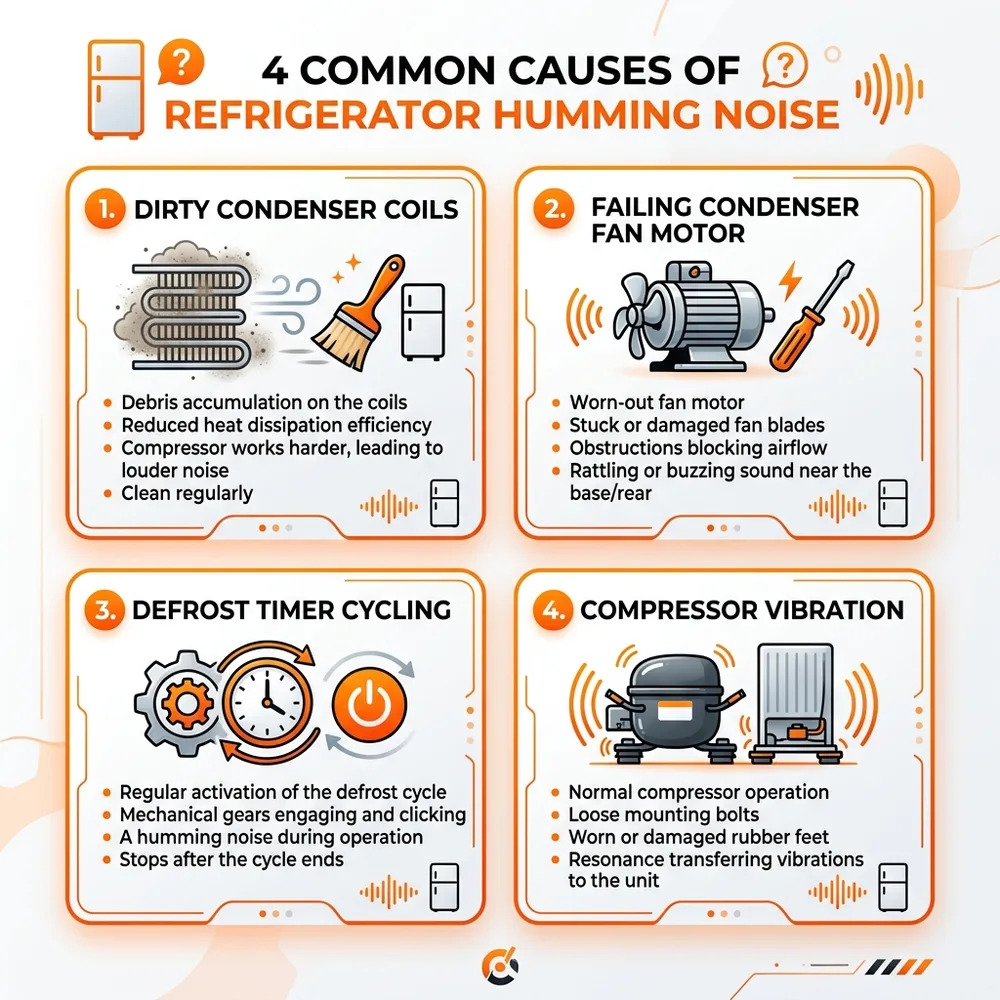
Normal Fridge hum vs. a Problem Noise
A properly working refrigerator produces a steady, low-pitched hum from the compressor running, typically 40 to 45 decibels, about the level of a quiet conversation. You will also hear the clicking of the compressor starting up and shutting down (normal), and occasionally a gurgling sound as refrigerant moves through the system (normal). What’s not normal is a hum that has noticeably increased in volume over recent weeks, a high-pitched whine or buzz (especially from the back or bottom), a rattling or vibrating hum that changes when you press on the fridge panels, or a loud grinding noise that starts and stops.
To identify which part is making the noise, listen from different positions. A noise from the back of the fridge at the bottom points to the condenser fan or compressor. A noise from inside the freezer compartment is typically the evaporator fan. A vibration that seems to come from everywhere can be the fridge touching a cabinet or wall, the drain pan vibrating loose, or an internal component mounting that has come loose.
Condenser Fan Motor Issues
The condenser fan sits at the back of the refrigerator, next to the compressor, and pulls air across the condenser coils to dissipate heat. In Jacksonville’s climate, this fan runs more hours per day than in northern cities, and it pulls in Florida’s humid, sometimes dusty, air over those coils continuously. The fan motor bearings wear out over time, and when they start to go, the sound is a distinctive louder hum or whirring noise that comes from the back-bottom of the fridge.
To confirm it is the condenser fan, pull the fridge away from the wall, locate the fan on the back panel near the compressor, and listen. If the noise stops when you unplug the fan connector (briefly), the fan motor is the source. Condenser fan motors are accessible by removing the back panel, but you still shouldn’t DIY it. If you’re looking for professionals to help you fix your fridge, let us help! Our expert technicians have the knowledge and experience needed in order to properly repair your fridge quickly and safely! Contact us today!
Dirty Condenser Coils in Florida Heat
Dirty condenser coils are one of the most common and most overlooked causes of increased refrigerator noise in Jacksonville homes. The condenser coils release the heat that the fridge removes from its interior. When they are coated in dust, pet hair, and the fine particulate matter that Florida homes accumulate in the humid air, they cannot release heat efficiently. The compressor compensates by running longer and harder, producing more noise while doing so.
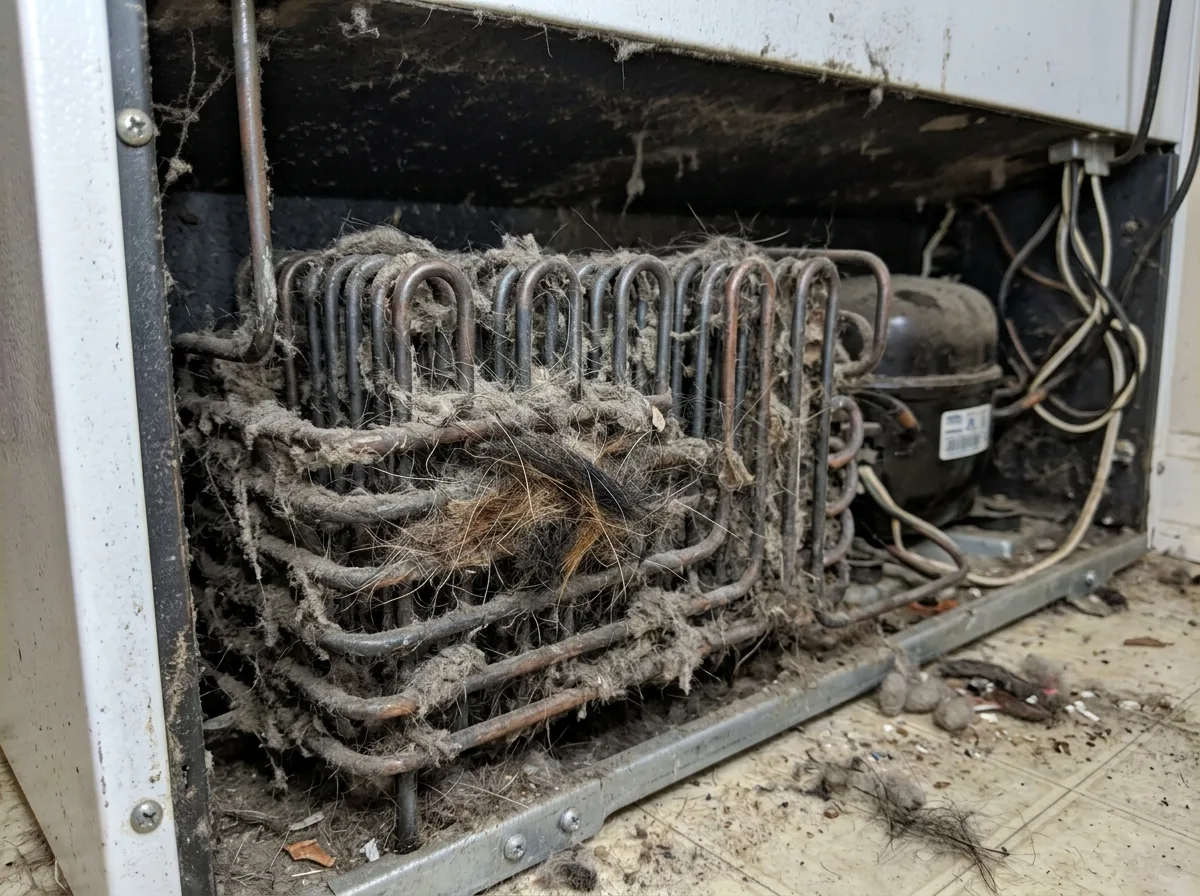
The fix is straightforward and free, vacuum the coils every 6 to 12 months. On most refrigerators the coils are either at the back of the unit or behind a grille at the bottom front. Use a vacuum with a brush attachment or a long-handled coil brush to remove accumulated buildup. This maintenance step also reduces electricity consumption, dirty coils can increase energy use by 15 to 25 percent according to appliance efficiency data.
Compressor Noise and When it Matters
The compressor is the heart of the refrigeration system, a sealed motor that pumps refrigerant around the system. A healthy compressor makes a steady, relatively quiet hum when running. Warning signs in compressor noise include a very loud hum that has gotten progressively louder over weeks or months, a clicking sound followed by the compressor failing to start (it tries to start, clicks off, and tries again, called hard starting), or a knocking or banging sound from the back of the fridge.
In the bold city’s climate, compressors in refrigerators older than 10 years are at higher risk of hard-start issues during the hottest months because the elevated ambient temperature makes the starting torque higher than the compressor was designed for. A hard-start kit (a capacitor that boosts the compressor’s starting power) is cheap and often extends the working life of an aging compressor, it is worth discussing with a technician before committing to a compressor replacement.
Evaporator Fan Noise From the Freezer
If the loud humming or whirring seems to come from inside the freezer, it is probably the evaporator fan. This fan circulates cold air over the evaporator coils and throughout the fridge. The noise from a failing evaporator fan motor is distinctive, a high-pitched whirring or squealing that often gets louder when you open the freezer door. Sometimes it stops briefly when you press on the back panel of the freezer, this confirms it is the fan and its mounting.
A second common cause of evaporator fan noise in fridges is ice accumulation around the fan blades. When the defrost system is not working properly, ice builds up on the evaporator and eventually reaches the fan blades, causing a loud rattling hum as the blades hit ice with each rotation. Accessing the evaporator coil area requires removing the freezer back panel, a 20-minute job on most top-freezer and side-by-side models, but more involved on French-door refrigerators.
Jacksonville Heat and Humidity
Jacksonville averages 233 days per year above 80 degrees Fahrenheit, with summer temperatures regularly hitting 94 to 97 degrees and humidity above 75 percent. This climate creates specific refrigerator stress patterns not seen in most US markets:
First, compressor run time is significantly longer. A refrigerator in a 68-degree kitchen runs its compressor roughly 40 to 50 percent of the time. In a Jacksonville home at 78 to 80 degrees in summer, that same fridge runs its compressor 60 to 70 percent of the time. The extra runtime means fans, bearings, and compressor components wear faster, a fridge that would last 16 years in Chicago might show noise and efficiency problems at 11 to 12 years here.
Second, the garage problem. Many homes store secondary refrigerators or chest freezers in garages. A garage in Jacksonville can hit 110 to 120 degrees on summer afternoons. Most refrigerators are rated to operate in ambient temperatures up to 90 degrees F, running one continuously above that rating forces the compressor to work beyond its design parameters, producing noise and dramatically shortening its life.
Third, door seal stress. The large temperature differential between a kitchen at 78 degrees and the interior of the fridge at 37 degrees creates significant condensation pressure on door gaskets. Gaskets on our fridges see more thermal cycling than in cooler climates, leading to earlier cracking and degradation.
What to try yourself
Work through these in order before calling for service:
- Pull the fridge away from the wall and check that it is not vibrating against the wall, cabinet, or floor. A fridge touching a wall produces a resonant hum that sounds much louder than the actual source. Make sure it has at least 1 inch of clearance on all sides.
- Check the drain pan under the fridge (usually accessed from the front grille). If it is loose or rattling, that can produce a significant vibration hum. Reseat or secure it.
- Vacuum the condenser coils thoroughly, both the coils themselves and the surrounding area. Use a coil brush to get between the fins. Do this in a well-ventilated area since Jacksonville dust can contain fine particulates.
- Listen with the freezer open vs. closed while the noise is happening. If it changes noticeably when the freezer door is open, the evaporator fan is the likely source.
- Check the condenser fan blades for debris, a small piece of paper, plastic bag fragment, or debris that has blown into the back compartment can catch on the fan blades and produce a loud intermittent noise.
Wrapping it up
A louder-than-normal refrigerator hum is usually your appliance’s way of warning you that something is starting to struggle. In our city’s heat and humidity, refrigerators work harder year-round, which means fans, compressors, and coils wear out faster than many homeowners expect. The good news is that many noise issues can be caught early with simple maintenance like coil cleaning and airflow checks. If the noise keeps getting worse or cooling performance drops, it is best to have the fridge inspected before a small problem turns into a major repair.
Frequently asked questions
Sources and references
- US Department of Energy – Refrigerator Energy Efficiency Tips
- NWS Jacksonville – Local Climate Data
- Consumer Reports – Refrigerator Reliability
Refrigerator making noise in Jacksonville?
Max Appliance Jacksonville serves the First Coast including St. Augustine, Orange Park, and Ponte Vedra.
Book a repair today