
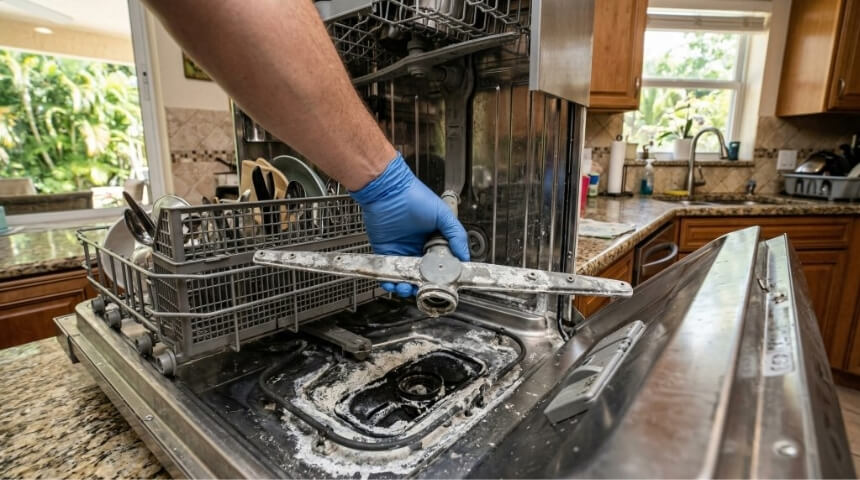
Almost every appliance failure we see that involves a water inlet, a heating element, or a spray arm can be traced back to one Jacksonville-specific problem: the calcium and magnesium dissolved in our tap water. We pull most of our drinking water from the Floridan aquifer, which gives us safe water with a uniquely high mineral load. That mineral load is what plumbers call “hard water,” and it slowly cakes the inside of every appliance that touches it. Here is how it actually causes damage, the appliances most affected, and the fixes that work.
How Hard is our Water?
Water hardness is measured in either grains per gallon (gpg) or parts per million (ppm) of calcium carbonate. Per the most recent JEA Water Quality Report, Jacksonville’s distributed water averages 258 ppm depending on the well field, which translates to roughly 15 grains per gallon. The USGS Water Hardness Guide classifies anything above 7 gpg as “hard” and above 10.5 gpg as “very hard.” That puts most Jacksonville neighborhoods squarely in the very hard range.
The Floridan aquifer flows through limestone bedrock for thousands of years before reaching the wells. Limestone is calcium carbonate, and a small fraction of it dissolves into the water on the way. The result is safe, clean drinking water that also happens to leave a mineral fingerprint on every surface it touches inside your appliances.
How Hard Water Damages Appliances
The damage happens in three mechanical ways and one chemical way. All four matter for the lifespan of the appliance.
1. Scale buildup on heating elements
Every appliance that heats water (dishwasher, washing machine, water heater, coffee maker, ice maker valve) has a heating element or a heated surface. Hard water minerals come out of solution faster when water is heated, and they bond to that hot surface as a hard, white, insulating crust called scale. A scaled element is an insulated element. It has to work longer and hotter to do the same job, which raises the energy bill, slows the cycle, and eventually burns the element out.
2. Clogged spray arms, jets, and inlet screens
Dishwasher spray arms, washing machine inlet screens, and refrigerator ice maker fill tubes are all narrow-orifice components. Mineral scale narrows those orifices, which weakens spray pressure (dishes come out dirty), restricts fill rates (cycles run long), and eventually blocks them entirely. If the damage is already done or your dishwasher still doesn’t work after cleaning, give us a call. Our professional team can fix your broken dishwasher, usually the same day you call.
3. Damage to seals and valves
Solenoid water inlet valves on dishwashers and washers seal against rubber diaphragms. Mineral particles caught in the seal cause slow leaks that the appliance compensates for by running longer fill cycles, which puts more stress on the valve until it sticks open and floods the floor.
4. Soap inactivation
Calcium ions in hard water react with detergent surfactants and inactivate them before they can clean. That is why dishes often come out spotted and laundry feels stiff. Most homeowners respond by using more detergent, which leaves residue and makes the problem worse.
Appliances Most Affected by Hard Water
Dishwasher
The most visible victim. White film on glassware, cloudy plastics, rough deposits inside the tub, and weak spray pressure are all hard water symptoms. Most dishwashers need their spray arms removed and descaled with a citric acid soak every 12 to 18 months. A failing inlet valve from mineral buildup is the most common dishwasher failure in this market.
Washing machine
Front-load washers are particularly vulnerable. Hard water slowly clogs the rubber door seal drain channels with a black mineral and biofilm mix that smells like mildew, restricts the inlet hose screens, and leaves laundry feeling stiff. High-efficiency front-loaders are also more sensitive to detergent dosing, and hard water requires noticeably more detergent than the manufacturer label suggests, unless you soften the water.
Ice maker and refrigerator water dispenser
Mineral scale builds up on the fill tube, the solenoid valve, and the ice mold fingers, eventually causing slow fills, hollow cubes, jammed harvest cycles, and complete failure. Replacing the inline water filter every 6 months helps but does not remove dissolved minerals.
Tankless and tank water heaters
Hard water is the leading cause of premature water heater failure in Northeast Florida. A tank heater accumulates a layer of sediment on the bottom that insulates the burner and cracks the glass lining; a tankless heater scales the heat exchanger and triggers error codes within 2 to 4 years if not flushed annually.
Protect Your Appliances From Jacksonville Hard Water
Rinse Aid and Citric Acid Maintenance
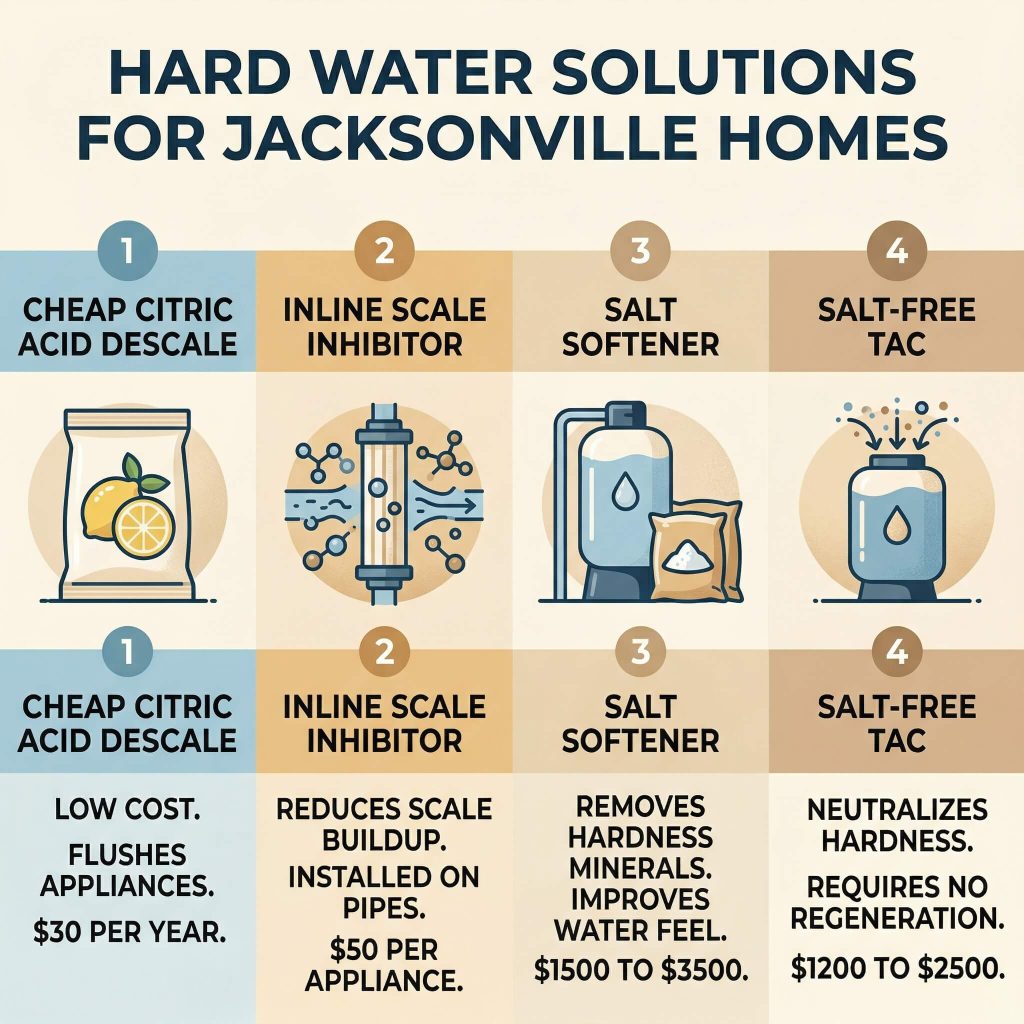
Use a rinse aid in every dishwasher cycle. Run a citric acid descale cycle (one cup of citric acid powder in an empty dishwasher on the hottest cycle) every 3 months. Run an empty hot wash with two cups of distilled white vinegar in the washing machine drum every 3 months. Replace the refrigerator inline water filter every 6 months. This routine noticeably extends the life of every water-using appliance in the house.
Point-of-use Scale Inhibitor
Phosphate-based inline scale inhibitors installed on the supply line of the dishwasher and ice maker need cartridge replacement once a year. They do not soften the water, but they keep the dissolved minerals in suspension so they pass through the appliance instead of crusting onto heating elements and spray arms. For renters and people who do not want a whole-house system, this is the most cost-effective intervention.
Whole-House Water Softener
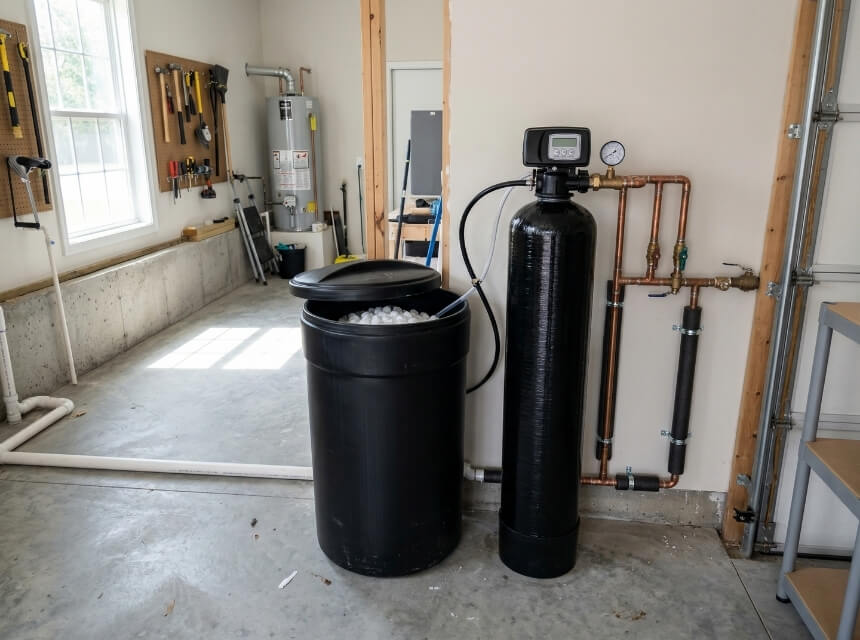
A salt-based ion exchange softener installed where the main line enters the house removes the calcium and magnesium from every drop of water in the home. Soap lathers, dishes come out clear, laundry feels soft, and water heaters last twice as long. But he system needs salt added every 4 to 6 weeks. For a homeowner planning to stay in the house more than three years, the savings on appliance replacement and detergent typically pay back the system within five years.
Salt-Free Template-Assisted Crystallization System
A newer technology that converts dissolved calcium into harmless microscopic crystals instead of removing it. Salt-free systems do not soften the feel of the water but they prevent scale formation just as well as salt softeners for protecting appliances, and hey need almost no maintenance. A good middle option for homeowners on a septic system who cannot discharge softener brine.
Local Appliance Experts you can Rely on
Hard water is just part of living in Jacksonville, but the damage it causes doesn’t have to be. Stay on top of simple maintenance, don’t ignore early signs like spots or slow fills, and pick a solution that fits your home and budget. Whether it’s a quick descale routine or a full softener, a little effort now can save you from bigger, more expensive problems down the line.
