

You toss in a load of towels, walk away, and come back an hour later to a drum full of warm, damp laundry that is somehow no drier than when you started. The drum spins, the timer counts down, but the heat is just gone. It is one of the most common calls we get from homeowners across Jacksonville, and the good news is that a dryer not heating usually traces back to a short list of culprits. Some you can check yourself in a few minutes, others need a technician. Our team handles fixes dryers in the Jacksonville area every day, and this is the same order we work through on a no-heat call.
Below we walk through why a dryer stops heating, what is safe to inspect on your own, and the few warning signs that mean you should stop and pick up the phone. Florida heat and humidity add a wrinkle of their own, so we will cover that too.
In this article
What ‘not heating’ actually looks like
Before you diagnose anything, it helps to be precise about the symptom, because “my dryer is broken” covers a lot of ground. A true no-heat fault means the drum turns and the machine runs through its cycle, but the air inside never gets warm. That is different from a dryer that will not turn on at all, or one that heats but takes forever because of poor airflow.
- No heat at all. The cycle runs, clothes come out room temperature or damp.
- Weak or intermittent heat. The dryer warms up, then quits partway, or barely heats on every load.
- Heats but will not dry. Often an airflow or venting problem rather than a heating part.
Knowing which bucket you are in narrows the cause fast. The rest of this guide focuses on the first two, where the heat source itself is failing or being shut off by a safety device.
Why a dryer stops producing heat
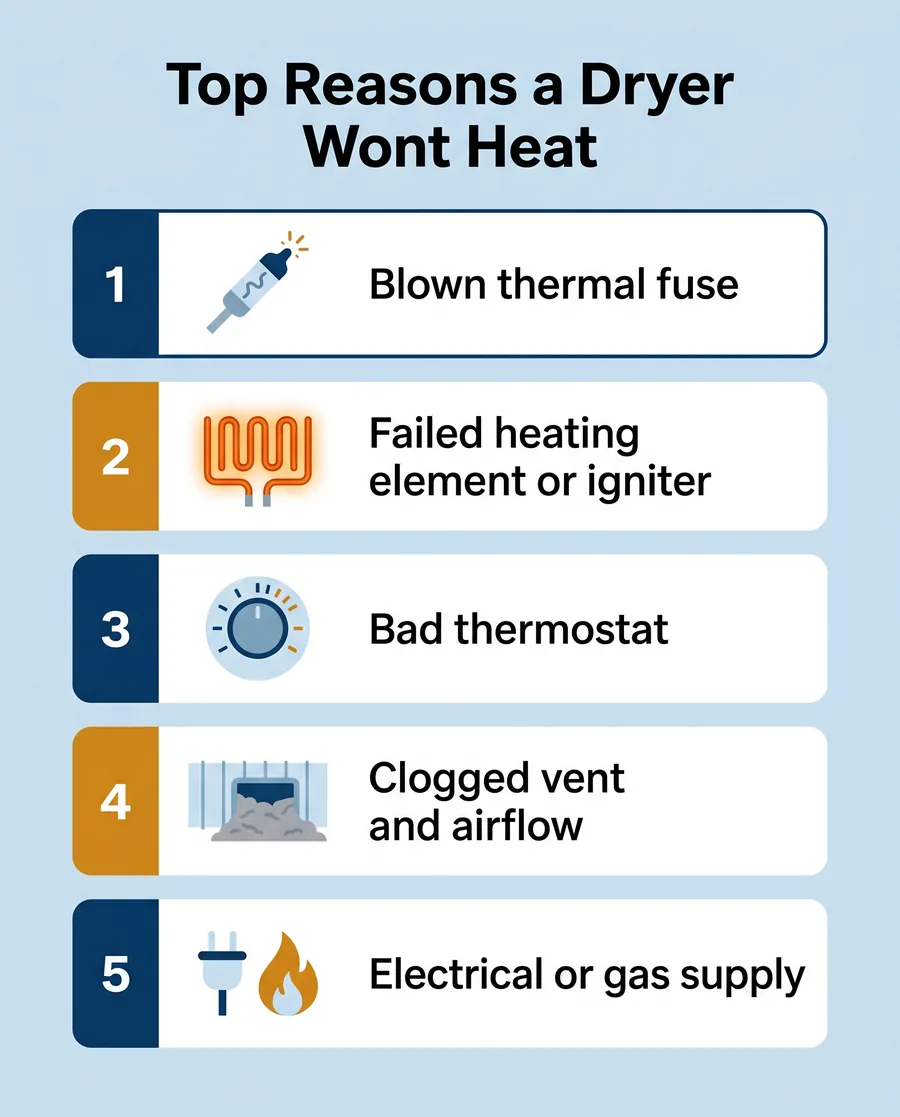
Whether you own an electric or a gas dryer, the machine makes heat, blows it through the drum, and relies on several safety parts to cut that heat if anything goes wrong. When one of those parts fails, the heat stops. Here are the usual suspects, roughly in the order we find them.
- A blown thermal fuse. This one-time safety device trips for good when the dryer overheats, almost always because of restricted airflow. Once it blows, the dryer can still tumble but will not heat. It is a frequent cause and a common reason a dryer suddenly goes cold with no warning.
- A failed heating element (electric) or igniter (gas). The electric element is a coil that glows hot, over years it can burn out and break the circuit. On a gas dryer, a worn igniter cannot light the burner, so no flame, no heat.
- A faulty thermostat or thermal cut-off. Cycling thermostats regulate temperature, and a limit thermostat shuts heat down if things get too hot. A stuck-open one keeps the heat off.
- A bad gas valve coil (gas models). If the coils that open the gas valve fail, the igniter may glow but the burner never lights.
- An electrical supply problem (electric models). An electric dryer runs on 240 volts through two legs. If one leg is lost, often from a partially tripped double breaker, the drum spins on 120 volts but the element gets no power.
Pro tip: the breaker test takes ten seconds
On an electric dryer that tumbles but will not heat, the very first thing to rule out is the breaker. A double-pole breaker can trip on one side and look fine at a glance. Switch it fully off, then firmly back on. If the heat returns, you just saved a service call. If it trips again right away, leave it off and call a pro, because a repeat trip points to a real electrical fault.
What to check first (safely)
Safety first: The tips here are for general guidance only. Max Appliance Repair Jacksonville is not responsible for any damage, injury, or cost resulting from action taken based on this content. Always unplug an appliance before you inspect it. Never attempt natural gas, refrigerant, or major electrical repairs yourself. If a step calls for anything you are not fully comfortable with, stop and call a licensed appliance technician.
A few checks are genuinely homeowner-friendly and account for a surprising share of no-heat calls. Do them in this order, and unplug the dryer (or shut the gas) before you touch anything beyond the lint screen and the exterior vent.
- Clean the lint screen and check the vent. A clogged screen or a blocked exterior vent hood chokes airflow, overheats the dryer, and trips the thermal fuse. Pull the screen, wash it if it has fabric softener buildup, and confirm the outside vent flap opens when the dryer runs.
- Reset the breaker (electric) or confirm the gas supply (gas). See the breaker tip above. For gas, make sure the supply valve behind the dryer is fully open and other gas appliances are working.
- Check the cycle setting. It sounds obvious, but an “Air Fluff” or “Air Dry” setting runs the drum with no heat by design. Confirm you are on a timed or auto heat cycle.
- Look for a kinked or crushed vent hose. Pull the dryer out a few inches and make sure the flexible duct behind it is not crushed flat against the wall.
Red flag: stop and call a pro now
If you smell gas, see scorched or melted wiring, notice a burning odor that is not just lint, or the dryer is hot to the touch on the outside, stop right there. Do not keep running it. Unplug it or shut the gas, open a window, and call a licensed technician. Per the NFPA clothes dryer safety guidance, dryers are a real fire risk, and a no-heat fault paired with any of these signs is not a DIY job.
How Jacksonville’s climate makes it worse
Northeast Florida is hot and humid for most of the year, and that works against your dryer in two ways. First, a laundry room with little ventilation traps heat and moisture, which makes it easier for a dryer to overheat and trip its thermal fuse. Second, our humidity means clothes go into the drum holding more water, so the machine runs longer and hotter on every load. Run a dryer hard in a warm garage in July and you are stacking the deck against those safety parts.
People often ask: does humidity really affect a dryer?
Yes, indirectly. Humid air carries more moisture into the laundry and into the room, so the dryer works harder and longer to finish a load. Longer, hotter cycles put more wear on heating elements, igniters, and thermostats over time. Good airflow matters even more here than in a dry climate. Keep the lint screen clean, keep the vent run short and clear, and give the laundry room some ventilation if you can.
When to call a technician
If you have cleaned the vent, reset the breaker, confirmed the cycle, and the dryer still will not heat, the fault is almost certainly inside the cabinet: a blown thermal fuse, a dead element or igniter, or a failed thermostat. Diagnosing those means opening the machine, testing parts with a meter, and working near 240-volt wiring or a gas burner. That is the line where calling a professional saves both money and risk.
A trained technician can pinpoint the failed part in one visit instead of you buying the wrong replacement and guessing.
How to prevent it next time
- Clean the lint screen every load. It is the single best habit for both performance and fire safety, and it keeps airflow up so the dryer never overheats.
- Clear the full vent run once a year. Lint builds up past the screen, deep in the duct. A clean run keeps cycles short and protects the thermal fuse.
- Do not overload the drum. Cramming in oversized loads blocks airflow and makes the machine run hot and long. Two normal loads dry faster than one giant one.
- Give the laundry room some air. In our climate, a little ventilation around the dryer helps it shed heat instead of cooking its own components.
A dryer is one of the harder-working appliances in a Florida home, and a little airflow discipline goes a long way. If you want to keep the rest of your kitchen and laundry running smoothly through the heat, our guide to how Jacksonville summers affect your appliances is a good next read.
Wrapping it up
A dryer that runs without heat is frustrating, but the cause is often more straightforward than homeowners expect. Simple issues like clogged vents, blocked airflow, or a tripped breaker account for many no-heat complaints, while failed heating components typically require professional diagnosis. Acting quickly is important, especially in our city’s hot, humid climate where longer drying times place extra stress on appliances. A little maintenance today can help prevent a much larger repair bill tomorrow.
Sources and further reading
- National Fire Protection Association (NFPA), “Clothes Dryer Safety Tip Sheet.” nfpa.org
- U.S. Fire Administration (USFA, FEMA), “Appliance and Electrical Fire Safety.” usfa.fema.gov
- ENERGY STAR, clothes dryer efficiency and care guidance. energystar.gov
- Word of Advice TV, “Dryer Not Drying Clothes” (video, embedded above).
- Max Appliance Repair Jacksonville, in-house no-heat diagnostic procedure.
Frequently asked questions
Download the free quick guide
Keep our printable step-by-step checklist by the laundry room so you know exactly what to check before you call.
Dryer still cold after the basics? We are here in Jacksonville.
Max Appliance Repair Jacksonville services every major brand across Jacksonville and Northeast Florida. If your dryer tumbles but will not heat, our technicians can diagnose and fix it fast, often the same day. Reach out to our team or learn more about our service to get your laundry routine back on track.
