
Faced with the choice to repair or replace washing machine problems, one rule cuts through most of the noise: if the fix costs more than half the price of a comparable new unit, and the machine is past the halfway point of its expected life, replacing it usually makes more sense. Under those thresholds, a washer that has broken down mid-cycle is very often worth saving. This guide gives you a clear framework instead of a coin flip.
We fix and, when it is honestly the better call, help homeowners move on from washing machines all over Jacksonville. What follows is how we think it through, minus the sales pressure.
In this article
The 50 percent rule, explained
The most useful shortcut in this whole decision is the 50 percent rule. It says that if a repair costs more than half of what a comparable new machine would cost, you are usually better off replacing. Spend less than half, and repair is typically the smarter move. It is not a law, it is a sanity check, and it keeps you from pouring good money into a machine that is on its way out.
The 50% rule is only a general heuristic. Base the decision on a written repair quote, model age, warranty, parts availability, efficiency and overall condition.
Quick take
Repair when the fix costs less than half the price of a comparable new machine and the unit is not near the end of its life. Replace when the repair crosses that halfway line, especially on an older machine or a second major failure.
How age changes the math
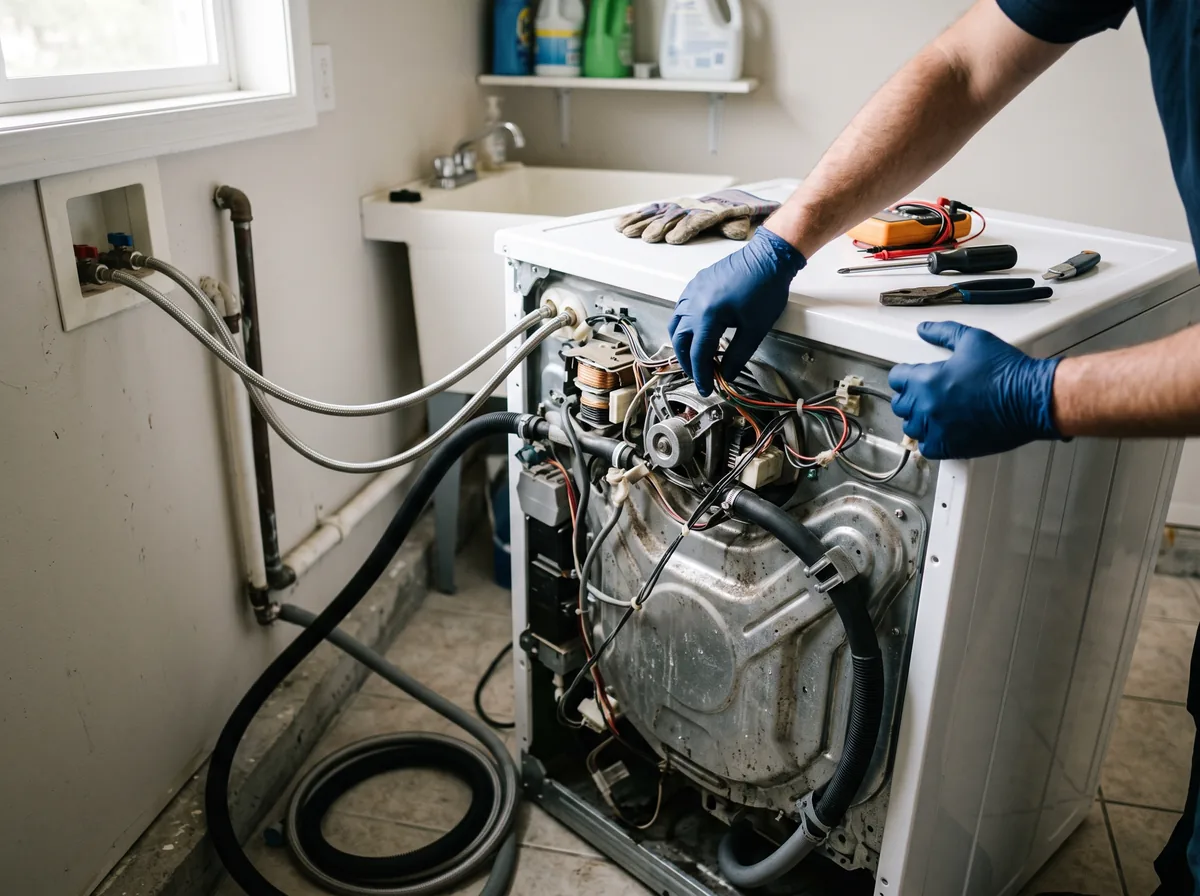
A washing machine usually lasts about 10 to 14 years. Where your machine sits on that timeline changes the answer more than almost anything else. A three-year-old washer with a bad pump is an easy repair. A twelve-year-old washer with the same bad pump is a warning sign that other parts are close behind.
Here is the practical version. In the first third of its life, repair almost anything short of a cracked tub. In the middle third, run the 50 percent rule and lean toward repair. In the final third, be strict, because a machine that old is likely to need a second or third repair soon, and those add up fast. The same logic that helps you judge a dryer that has stopped producing heat applies to washers too: age plus repair cost tells the story.
The repair or replace decision matrix
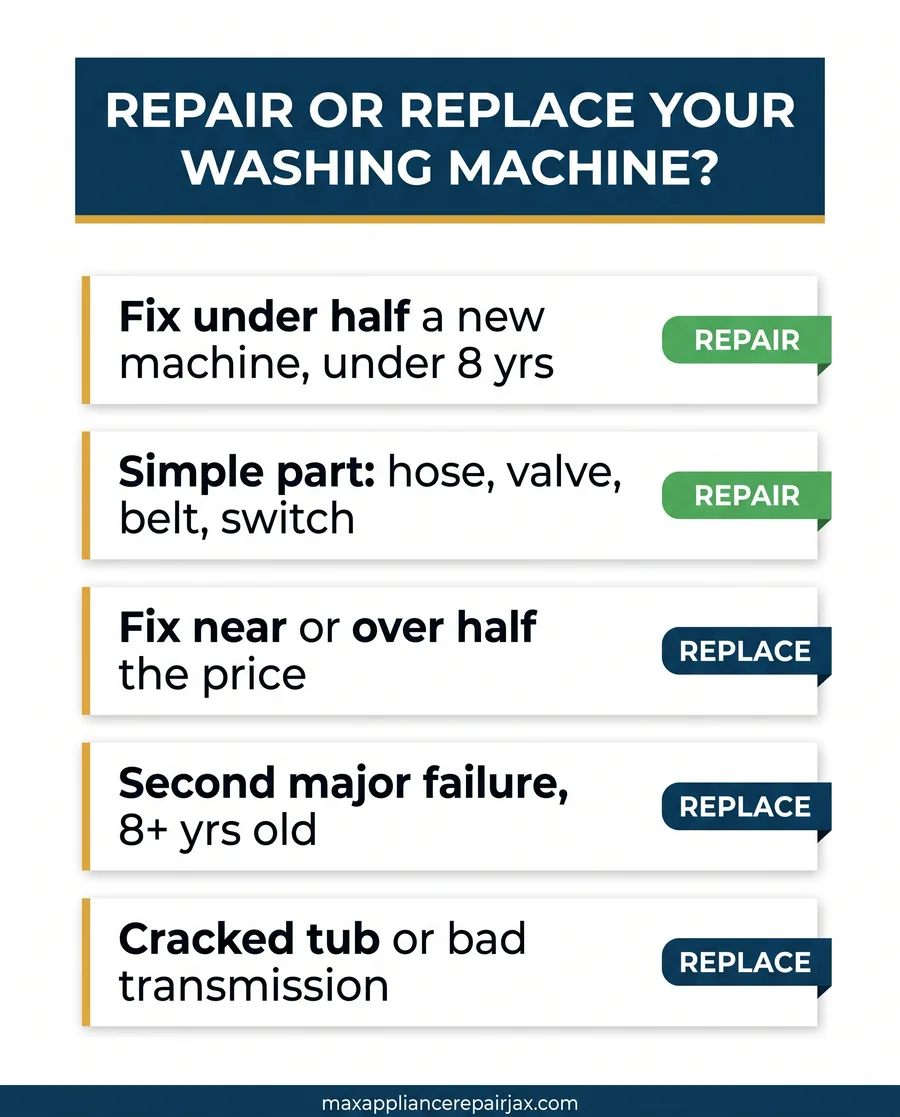
Put the pieces together and the repair or replace washing machine call gets a lot clearer. This matrix weighs the three things that actually decide it: the machine’s age, the repair cost against the 50 percent line, and the type of problem. No dollar amounts here, because your quote and local prices fill those in.
| Situation | Age of machine | Lean toward |
|---|---|---|
| Repair well under half a new machine’s price | Under 8 years | Repair |
| Repair well under half, minor part | 8 to 12 years | Repair |
| Repair near or over half the price | Any age | Replace |
| Second or third major failure | 8+ years | Replace |
| Cracked tub, bad transmission, or rusted frame | Any age | Replace |
| Simple fix (hose, valve, switch, belt) | Any age | Repair |
Which problems are worth fixing
Not all washer problems carry the same weight. Some are cheap, common, and absolutely worth repairing at almost any age. Others signal that the machine’s core has given out and no repair will make it reliable again.
Usually worth fixing:
- A washer that will not drain, often just a clogged pump or drain hose.
- A machine that will not fill, commonly a failed water inlet valve.
- A broken lid switch or door lock that stops the cycle from starting.
- A worn belt or a leaking hose connection.
- A washer that shakes hard, sometimes just worn shock absorbers or an unbalanced load.
Usually points to replacement:
- A cracked or leaking inner or outer tub.
- A failed transmission or a seized main bearing (often a loud grinding on spin).
- A burned-out motor on an older machine.
- A rusted-through cabinet or frame.
- A control board failure on a machine already past 10 years.
Pro tip
Before you write off a shaking or noisy washer, check that it is level and that the shipping bolts were removed at install. A surprising number of dramatic washer symptoms come down to a machine that is not sitting flat on the floor, which is a five-minute fix, not a new appliance.
The Florida factor
Jacksonville adds a few thumbs on the scale. Our hard water leaves mineral scale that wears valves, seals, and heating elements faster, so parts here fail a little sooner than the manual predicts. Humidity in garages and laundry rooms speeds up rust on older metal cabinets, which can push a borderline machine into the replace column.
There is an efficiency angle too. In a climate where you run the air conditioner half the year, an old washer that also runs the water heater harder with every hot load is quietly expensive. When you weigh repair against replacement on a decade-old machine, factor in the water and energy a modern unit would save. For current efficiency standards, the ENERGY STAR clothes washer guide is a good neutral reference.
Download the free quick guide
A one-page decision guide to help you weigh a washer repair against a replacement.
Frequently Asked Questions
Staring at a broken washer and not sure which way to go? Max Appliance Repair gives you an honest diagnosis and a straight repair-or-replace recommendation across Jacksonville, including Avondale, Springfield, Fleming Island, and the Northside. Book a service appointment and we will hand you the numbers you need to make the call, not a pitch.
